The Great Debate: To Start or Not To Start? Week 8
A position-by-position look at this week’s most difficult fantasy lineup decisions, the matchups behind them, and a few choices that shouldn’t be so difficult.

“Don't worry about the score at any point in the game.” — Dr. Lionel Rosen
In 1998, Nick Saban’s Michigan State Spartans were 4-5 and preparing to face undefeated No. 1-ranked Ohio State. Convinced his team had little chance of winning, Saban turned to psychiatrist Dr. Lionel Rosen for advice. Rosen’s suggestion was surprisingly simple: Stop worrying about winning. Instead, focus entirely on executing your assignment for the next six or seven seconds, the approximate length of a football play. Forget the scoreboard, the opponent’s reputation, and whatever happened on the previous play. Just focus on the next one.
Michigan State trailed 24-9 before stunning Ohio State in a 28-24 upset. Saban later credited that game with transforming his coaching philosophy, giving birth to what became known as The Process, an approach that would help him become one of the most successful coaches in college football history.
I’m still trying to appreciate the chaos and maintain a sense of gratitude, but determination is taking hold. As much as I’d love a Super Mario Bros.-style warp pipe straight to the fantasy playoffs, there’s no shortcut. Whether you’re undefeated, fighting for a playoff spot, or climbing out of the basement, we can’t control every injury or unpredictable outcome. What we can control is how we prepare, adapt, and respond. One week at a time. One decision at a time.
As always, you’ll find a recap of this week’s recommendations, along with last week’s receipts and lessons learned, at the end of the article. And if your particular dilemma isn’t covered, consult your preferred rankings or send me your start/sit questions @FFrealitycheck on X.
Quarterbacks
To Start: Jacoby Brissett at Dallas Cowboys
Jacoby Brissett has been frustratingly inconsistent, managing just two QB1 finishes through seven games despite averaging more than 40 pass attempts per contest. However, his substantial passing volume becomes considerably more appealing against one of the league’s most generous defenses.
Here’s what opposing quarterbacks have done against the Cowboys:
- Week 1: Jaxson Dart, 230 yards, 3 TD (54 rushing yards)
- Week 2: Jayden Daniels, 96 yards, 1 TD (69 rushing yards); Marcus Mariota, 111 yards, 1 TD (3 rushing yards)
- Week 3: Lamar Jackson, 186 yards, 2 TD (50 rushing yards)
- Week 4: C.J. Stroud, 347 yards, 2 TD (12 rushing yards)
- Week 5: Jalon Daniels, 189 yards, 1 TD (23 rushing yards)
- Week 6: Jordan Love, 276 yards, 1 TD, 1 INT (12 rushing yards, 1 rushing TD)
- Week 7: Tanner McKee, 211 yards, 1 TD, 1 INT
Arizona is a seven-point road underdog in a game with a 54.5-point over/under, giving the Cardinals an implied total of approximately 24 points.
Brissett has attempted at least 35 passes in six of seven games, including 48 against Denver last week. Unfortunately, he’s averaging just 5.7 yards per attempt, and that volume hasn’t consistently translated into fantasy production. Still, with Trey McBride, Michael Wilson and Kendrick Bourne providing capable receiving options, this matchup offers considerable upside.
We’ve already seen Brissett squander favorable opportunities, and his lack of rushing production makes him heavily dependent on passing efficiency and touchdowns. However, Dallas has struggled to contain opposing passing attacks, and Arizona should have plenty of reasons to throw. I’m willing to trust Brissett as a streaming option this week.
Not To Start: Bo Nix vs. Kansas City Chiefs
Bo Nix finally delivered a strong fantasy performance last week against Arizona. Unfortunately, 62 of his 73 rushing yards came on a single touchdown run, while his lone passing TD was a screen pass that RJ Harvey turned into a 52-yard score. I’m not convinced those explosive plays represent a meaningful turnaround for Denver’s struggling passing attack.
Here’s what opposing quarterbacks have done against the Chiefs:
- Week 1: Bo Nix, 131 yards, 1 TD, 1 INT (2 rushing yards)
- Week 2: Daniel Jones, 210 yards, 1 TD, 1 INT (10 rushing yards)
- Week 3: Malik Willis, 210 yards, 1 INT (56 rushing yards)
- Week 4: Kirk Cousins, 365 yards, 2 TD, 1 INT
- Week 5: Bye
- Week 6: Justin Herbert, 204 yards, 1 INT (26 rushing yards)
- Week 7: Sam Darnold, 257 yards, 1 TD, 1 INT (17 rushing yards)
Kansas City has allowed just five passing TDs through six games while recording six interceptions. Denver is a 1.5-point home underdog in a game with a 40.5-point over/under, giving the Broncos an implied total of just 19.5 points.
Nix was particularly ineffective against Kansas City in Week 1, managing 131 passing yards while absorbing four sacks. The Chiefs pressured him on more than half his dropbacks, and he completed just four of 13 passes under pressure for 11 yards.
Nix’s rushing ability provides some upside, but he’s thrown multiple TDs just once this season. After last week’s performance, it’s tempting to believe he’s finally turning things around. However, against a defense that already dismantled him once this season, I’d rather keep him on the bench.
Not Much to Debate
Kirk Cousins at the New York Jets is a start I’m comfortable with. Cousins leads the NFL with 16 passing TDs through seven games and has scored more than 18.5 fantasy points in five of his last six contests. Tre Tucker has emerged as a dependable receiving weapon, and Las Vegas continues leaning heavily on its passing attack. The Jets have also surrendered seven QB touchdowns over their last three games. Despite the Raiders’ struggles, Cousins has consistently delivered useful fantasy production, and I’m trusting him as a low-end QB1.
On the other hand, Patrick Mahomes at Denver is a sit I’d seriously consider for the second consecutive week. Mahomes has failed to score a touchdown in either of his last two games, producing just 16.5 combined fantasy points while throwing two interceptions. Denver has allowed only eight passing TDs through seven games and already frustrated Mahomes in Week 1. His talent makes him difficult to bench, but between his recent struggles, Kansas City’s rushing success and another unfavorable matchup, I’d explore stronger alternatives.
Running Backs
To Start: Rhamondre Stevenson at Miami Dolphins
Rhamondre Stevenson has been difficult to trust this season, particularly after his six-carry, 22-yard rushing performance against Chicago last week. Fortunately, he salvaged his afternoon with five receptions for 93 yards and a TD. That receiving involvement could be especially valuable against a Miami defense that has struggled to contain opposing running backs.
Here’s what opposing running backs have done against the Dolphins:
- Week 1: Ashton Jeanty, 23 carries, 102 yards (6 rec., 45 yards, 2 TD)
- Week 2: Christian McCaffrey, 10 carries, 23 yards, 2 TD (4 rec., 43 yards)
- Week 3: Kenneth Walker III, 18 carries, 70 yards, 1 TD (2 rec., 3 yards, 1 TD)
- Week 4: Aaron Jones, 20 carries, 94 yards (4 rec., 34 yards)
- Week 5: Samaje Perine, 14 carries, 68 yards (2 rec., 10 yards, 1 TD)
- Week 6: Bye
- Week 7: Braelon Allen, 17 carries, 104 yards (6 rec., 30 yards)
Miami has surrendered eight total TDs to running backs through six games, including five receiving scores. New England is a seven-point road favorite in a game with a 44-point over/under, giving the Patriots an implied total of 25.5 points.
Stevenson has averaged just 13.9 touches and 69.8 scrimmage yards per game, and other backs remain involved in the backfield. However, Stevenson continues to command the more valuable receiving and goal-line opportunities. His preference for running between the tackles also aligns favorably with a Dolphins’ defense that has struggled against gap-blocking schemes.
There’s certainly no guarantee Stevenson delivers another productive receiving performance, particularly if New England controls the game through its rushing attack. However, Miami has allowed an opposing running back to produce at least 100 scrimmage yards or score a touchdown in every game this season. With a favorable projected game script and multiple avenues to fantasy production, I’m comfortable trusting Stevenson as an RB2 this week.
Not To Start: Quinshon Judkins at Pittsburgh Steelers
Quinshon Judkins finally broke out against Tennessee last week, rushing for 96 yards and two TDs on 17 carries. Unfortunately, he’s now facing a considerably more difficult opponent.
Here’s what opposing running backs have done against the Steelers:
- Week 1: Bijan Robinson, 21 carries, 83 yards (8 rec., 90 yards, 1 TD)
- Week 2: TreVeyon Henderson, 16 carries, 76 yards, 1 TD
- Week 3: Chase Brown, 13 carries, 61 yards (2 rec., 8 yards)
- Week 4: Quinshon Judkins, 17 carries, 53 yards, 1 TD (6 rec., 43 yards)
- Week 5: Jonathan Taylor, 15 carries, 45 yards (3 rec., 37 yards)
- Week 6: Bucky Irving, 19 carries, 46 yards (2 rec., 3 yards)
- Week 7: Alvin Kamara, 6 carries, 5 yards (7 rec., 57 yards)
Pittsburgh has allowed just three rushing TDs to running backs through seven games and has held opposing backfields to 135 rushing yards combined over its last three games. Cleveland is a 3.5-point road underdog in a game with a 39-point over/under, giving the Browns an implied total of approximately 18 points.
Judkins actually performed well against Pittsburgh in Week 4, but his six receptions accounted for a substantial portion of that production. Those opportunities came while Dylan Sampson was sidelined. In his return against Tennessee, Sampson played 46% of snaps compared to Judkins’ 53%, handling nine touches for 77 scrimmage yards while assuming much of the receiving work.
Judkins remains Cleveland’s primary early-down runner, averaging more than 18 touches per game. However, he’s struggled with efficiency, and Pittsburgh has consistently limited rushing production. Without dependable receiving involvement, he’s increasingly reliant on volume and touchdowns. His strong performance last week makes benching him uncomfortable, but against a difficult divisional opponent, I’d rather explore alternatives.
Not Much to Debate
Bhayshul Tuten vs. Indianapolis is a start I’m comfortable with coming out of Jacksonville’s bye. Tuten has earned at least 16 opportunities in four of his six games. The Jaguars are 9.5-point home favorites with an implied total of 28 points, and Indianapolis recently traded defensive lineman DeForest Buckner to San Francisco.
On the other hand, Jonah Coleman vs. Kansas City is a sit I’d consider if I have a reasonable alternative. Coleman returned last week and immediately led Denver’s backfield with nine carries for 54 yards, adding two receptions for 15 yards. That’s an encouraging development, particularly with Sean Payton expressing interest in expanding his role. However, J.K. Dobbins and RJ Harvey are likely to remain involved, and Kansas City has been one of the league’s toughest defenses against running backs. With Denver projected for just 19.5 points, scoring opportunities could also be limited. Coleman might be your best available option given the injuries and bye weeks, but I’d temper expectations against such a difficult opponent.
Wide Receivers
To Start: Ja’Kobi Lane at Buffalo Bills
I’m taking a gamble with rookie Ja’Kobi Lane this week. After missing four games with a fractured wrist, Lane has caught seven passes for 65 yards in two games since returning. Those numbers aren’t particularly encouraging, but his involvement is growing, and Buffalo presents an excellent opportunity for a breakout.
Here’s what opposing wide receivers have done against the Bills:
Week 1:
- Nico Collins: 7 rec., 75 yards, 1 TD
- Jaylin Noel: 2 rec., 53 yards
Week 2:
- Amon-Ra St. Brown: 9 rec., 142 yards, 2 TD
- Jameson Williams: 2 rec., 33 yards
Week 3:
- Tre Harris: 6 rec., 76 yards
- Ladd McConkey: 4 rec., 66 yards
Week 4:
- Romeo Doubs: 6 rec., 58 yards, 2 TD
- Efton Chism III: 2 rec., 42 yards, 1 TD
Week 5:
- Puka Nacua: 17 rec., 138 yards, 1 TD
- Davante Adams: 5 rec., 51 yards, 2 TD
Week 6:
- Tre Tucker: 5 rec., 97 yards, 2 TD
Week 7: Bye
Buffalo has surrendered 11 receiving TDs to wide receivers in six games, including eight over its last four contests. Baltimore is a three-point road underdog in a game with a 54.5-point over/under, giving the Ravens an implied total of approximately 26 points.
Lane ran 30 routes against Cincinnati last week, second among Baltimore’s receivers behind Zay Flowers, and drew five targets, including two in the red zone. The potential return of Lamar Jackson would also provide a significant boost to the offense.
Admittedly, trusting a rookie with just eight receptions this season is risky, especially with Flowers commanding most of the receiving opportunities. However, Buffalo has repeatedly surrendered productive performances to opposing receivers, and Lane should have opportunities in a potentially high-scoring contest. I’m willing to gamble on him as a deeper-league FLEX, particularly if Jackson returns.
Not To Start: Jameson Williams vs. Minnesota Vikings
Jameson Williams has finally started delivering the explosive performances fantasy managers have been waiting for, catching seven passes for 138 yards and four TDs over his last two games. Unfortunately, he now faces a Minnesota defense that has been exceptionally difficult for opposing wide receivers.
Here’s what opposing wide receivers have done against the Vikings:
Week 1:
- Christian Watson: 6 rec., 147 yards, 2 TD
- Matthew Golden: 6 rec., 95 yards
Week 2:
- Rome Odunze: 3 rec., 43 yards
- Kalif Raymond: 5 rec., 40 yards
- Luther Burden III: 3 rec., 32 yards
Week 3:
- Emeka Egbuka: 5 rec., 62 yards
- Ted Hurst: 1 rec., 40 yards, 1 TD
Week 4:
- Malik Washington: 5 rec., 67 yards
- Kevin Coleman Jr.: 1 rec., 3 yards
Week 5:
- Chris Olave: 4 rec., 46 yards
- Devaughn Vele: 4 rec., 26 yards
Week 6: Bye
Week 7:
- Keenan Allen: 3 rec., 31 yards
- Josh Downs: 2 rec., 18 yards
Since allowing Christian Watson to explode for 147 yards and two TDs in Week 1, Minnesota has surrendered just one receiving TD to wide receivers across its next five games. No opposing receiver has surpassed 67 yards during that stretch.
Detroit is a three-point home favorite in a game with a 46.5-point over/under, giving the Lions an implied total of approximately 25 points.
Williams has played at least 82% of Detroit’s offensive snaps in every game, but he’s averaging just 6.3 targets per contest, with Amon-Ra St. Brown commanding the largest share. His production remains heavily dependent on explosive plays and touchdowns, which Minnesota has consistently prevented.
Of course, Williams is talented enough to overcome a difficult matchup, and his nine targets against Green Bay last week were encouraging. But after four touchdowns in two games, expectations are rising. Against one of the league’s toughest secondaries, I’d rather avoid chasing that production unless my alternatives are limited.
Not Much to Debate
Omar Cooper Jr. vs. Las Vegas and Tre Tucker at the New York Jets are both starts I’m comfortable with. Cooper has caught 11 passes for 218 yards and two TDs over his last two games. More importantly, he played ahead of Adonai Mitchell last week, suggesting his growing role is legitimate. Meanwhile, Tucker has caught at least four passes in six consecutive games, including 10 receptions for 200 yards and three TDs over the last two weeks. His 12 targets against the Rams were particularly encouraging, and Kirk Cousins continues leaning heavily on Las Vegas’ passing attack. Both receivers offer appealing WR3 or FLEX potential.
On the other hand, Ladd McConkey at the Los Angeles Rams is a sit I’d consider if he’s cleared to return this week. McConkey has managed just 13 receptions for 200 yards and one TD across five games. Injuries have interrupted his season, and the Chargers’ passing attack hasn’t provided dependable opportunities. With Los Angeles projected for just 19.5 points against a difficult Rams defense, I’d rather see McConkey reestablish a meaningful role and the Chargers’ passing offense show some competence before trusting him.
Tight Ends
To Start: Hunter Henry at Miami Dolphins
Hunter Henry has quietly become one of New England’s most dependable receiving options, recording at least 44 yards in four consecutive games. He caught all seven of his targets for 71 yards against Chicago last week, and now faces a Miami defense that has been particularly generous to opposing tight ends.
Here’s what opposing tight ends have done against the Dolphins:
Week 1:
- Michael Mayer: 6 rec., 32 yards
Week 2:
- George Kittle: 4 rec., 80 yards, 1 TD
Week 3:
- Travis Kelce: 2 rec., 59 yards, 1 TD
- Noah Gray: 3 rec., 39 yards
Week 4:
- T.J. Hockenson: 13 rec., 119 yards
Week 5:
- Erick All Jr.: 3 rec., 25 yards
- Tanner Hudson: 3 rec., 14 yards, 1 TD
- Mike Gesicki: 1 rec., 4 yards, 1 TD
Week 6: Bye
Week 7:
- Mason Taylor: 5 rec., 62 yards, 2 TD
Miami has surrendered six receiving TDs to tight ends in six games, allowing 74.7 yards per game to the position. New England is a seven-point road favorite in a game with a 43.5-point over/under, giving the Patriots an implied total of approximately 25 points.
Henry has caught 26 of 31 targets for 296 yards and two TDs this season, becoming a particularly valuable option for Drake Maye while New England’s receiving corps deals with injuries. However, rookie Eli Raridon is also emerging, catching three passes for 56 yards and a TD against Chicago.
Interestingly, Miami has been so vulnerable to tight ends that Raridon might even be worth considering in deeper leagues. He’s caught 12 of 16 targets for 168 yards and two TDs, although his limited opportunities make him considerably riskier than Henry.
Not To Start: Greg Dulcich vs. New England Patriots
Greg Dulcich delivered his best performance of the season against the Jets last week, catching all five of his targets for 86 yards. He’s also drawn at least five targets in three of his last four games, suggesting his role in Miami’s offense is expanding. Unfortunately, the matchup against New England isn’t nearly as inviting.
Here’s what opposing tight ends have done against the Patriots:
Week 1:
- AJ Barner: 2 rec., 13 yards
Week 2:
- Pat Freiermuth: 4 rec., 32 yards
- Darnell Washington: 1 rec., 7 yards
Week 3:
- Brenton Strange: 3 rec., 32 yards
Week 4:
- Dawson Knox: 2 rec., 13 yards
- Dalton Kincaid: 1 rec., 7 yards
Week 5:
- Brock Bowers: 8 rec., 110 yards, 1 TD
Week 6:
- Mason Taylor: 4 rec., 33 yards
- Kenyon Sadiq: 1 rec., 12 yards
Week 7:
- Colston Loveland: 7 rec., 69 yards, 1 TD
- Cole Kmet: 3 rec., 28 yards
New England has surrendered just two receiving TDs to tight ends through seven games, although Brock Bowers and Colston Loveland demonstrated that productive performances are possible. Miami is a seven-point home underdog, with an implied total of approximately 18 points.
Dulcich has caught 18 passes for 213 yards without a touchdown this season. His recent involvement is encouraging, but last week’s 86 yards accounted for roughly 40% of his season-long production. He’s also dealing with an ankle injury, adding another concern.
Perhaps Dulcich continues building on his recent success, particularly if Miami is forced to throw while playing from behind. However, with limited scoring opportunities and a more challenging matchup, I’d rather see another productive performance before trusting him in my fantasy lineup.
Not Much to Debate
T.J. Hockenson at Detroit is a start I’m comfortable with. He is coming off a performance where he caught four passes for 35 yards and a TD against Indianapolis. The matchup is particularly appealing, as Detroit has surrendered 10 receiving TDs to tight ends through seven games and allowed more than 100 receiving yards per contest to the position. Kyler Murray has increasingly involved Hockenson, and we already saw what he can accomplish against a vulnerable defense when he caught 13 passes for 119 yards against Miami.
On the other hand, Pat Freiermuth vs. Cleveland is a sit I’d consider if I have a reasonable alternative. Freiermuth has caught just four passes for 31 yards over his last two games, while Darnell Washington has scored in consecutive contests. Freiermuth actually found the end zone against Cleveland in Week 4, but managed just 17 receiving yards.
Recap
To Start
QB: Jacoby Brissett
RB: Rhamondre Stevenson
WR: Ja’Kobi Lane
TE: Hunter Henry (with Eli Raridon worth considering in deeper leagues)
Not Much to Debate: Kirk Cousins (QB), Bhayshul Tuten (RB), Omar Cooper Jr. and Tre Tucker (WR), T.J. Hockenson (TE)
Not To Start
QB: Bo Nix
RB: Quinshon Judkins
WR: Jameson Williams
TE: Greg Dulcich
Not Much to Debate: Patrick Mahomes (QB), Jonah Coleman (RB), Ladd McConkey (WR), Pat Freiermuth (TE)
Last Week’s Receipts (Week 7)
Scoring: Full PPR for RBs, WRs and TEs. QBs: 4-point passing TDs, -1 per INT.
Quarterbacks
To Start: ❌ Kyler Murray: 13.9
Not To Start: ✅ Patrick Mahomes: 7.0
Not Much to Debate:
🟡 C.J. Stroud (Start): 14.5 | ✅ Daniel Jones (Sit): 4.6
Running Backs
To Start: ✅ Josh Jacobs: 20.1
Not To Start: ❌ New York Giants Backfield: Cam Skattebo (19.1), Devin Singletary (14.5), Tyrone Tracy Jr. (8.7)
Not Much to Debate:
✅ Jaylen Warren (Start): 16.7 | ✅ Kendre Miller (Sit): 5.8
Wide Receivers
To Start: 🟡 Carnell Tate: 9.9
Not To Start: ✅ Josh Downs: 3.8
Not Much to Debate:
❌ Germie Bernard (Start): 5.7 | ✅ Courtland Sutton (Sit): 7.5
Tight Ends
To Start: ✅ T.J. Hockenson: 13.5
Not To Start: ❌ Harold Fannin Jr.: 13.1
Not Much to Debate:
🟡 Dallas Goedert (Start): 9.8 | 🟡 Dalton Schultz (Sit): 9.5
The Curious Case
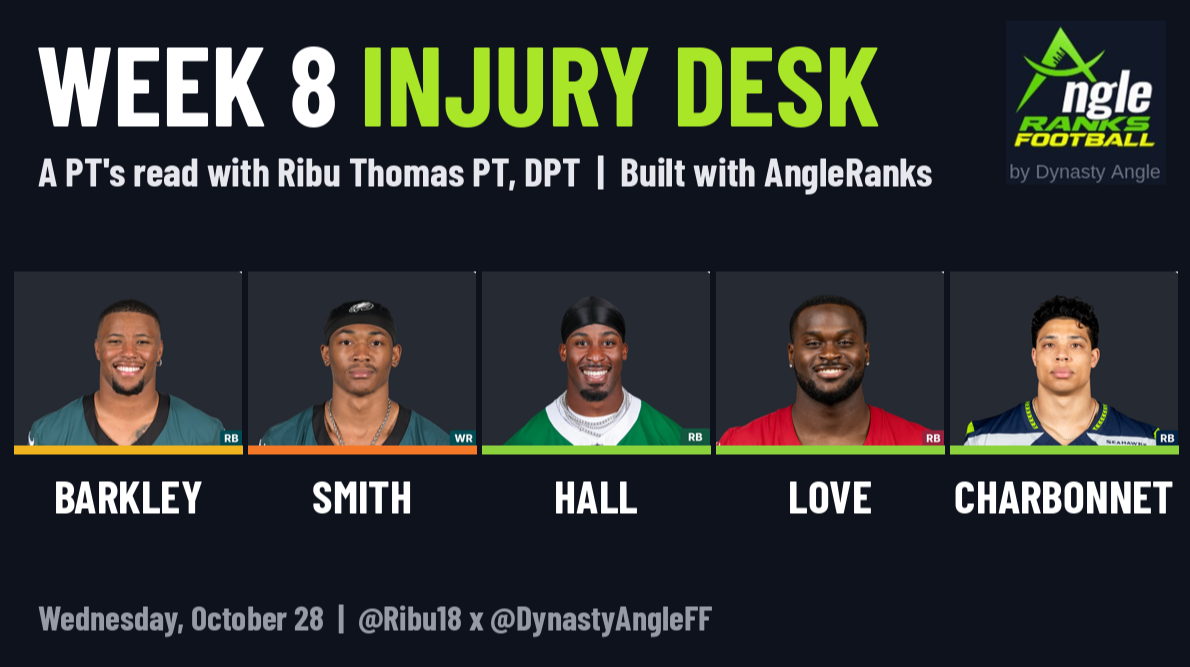
Zach Charbonnet: DNP (inactive)
Review
I’m officially done recommending Kyler Murray. That’s twice now he’s made me look foolish, so naturally, he’ll probably deliver his best performance of the season now that I’ve given up on him. At least benching Patrick Mahomes worked out, although it’s pretty hilarious that I specifically mentioned I wouldn’t bench him for someone like Geno Smith, who proceeded to have a great game. Whoops. I’m not particularly concerned about evaluating the Not Much to Debate selections, since the whole point is that those players had already earned the benefit of the doubt.
Josh Jacobs returned from the commissioner’s exempt list and exceeded even my expectations in his first game back. Unfortunately, the entire Giants’ backfield apparently read my recommendation to bench them and decided to prove me wrong. All three delivered useful performances, including an impressive outing from Cam Skattebo. In fairness, the report that Skattebo would reclaim his featured role emerged after I wrote last week’s article. That information certainly would’ve changed my recommendation.
Josh Downs continues to disappoint, and I’m hoping he’s traded somewhere willing to make him a more significant part of its offense. Carnell Tate managed to contribute against Cleveland, but not nearly enough to justify our confidence.
At tight end, T.J. Hockenson rewarded our trust with a touchdown, and Harold Fannin Jr punished our doubt with a score of his own. Good luck predicting Cleveland’s receiving production from week to week. Still, it was encouraging to see Fannin involved again, and hopefully that continues.
The biggest lesson this week is the importance of adapting to new information. Injuries, depth charts, coaching decisions and projected workloads can change considerably between writing an article and Sunday kickoff. We can make reasonable recommendations based on the available evidence, but we also need to remain willing to reconsider those conclusions as new information emerges. Sometimes the difference between a good and bad call is simply knowing something on Sunday that we didn’t know on Friday.

More from The Inside Angle

Put this into your own rankings
Build a tier board, compare it to Expert Consensus, and export a clean graphic in minutes.
Start Building